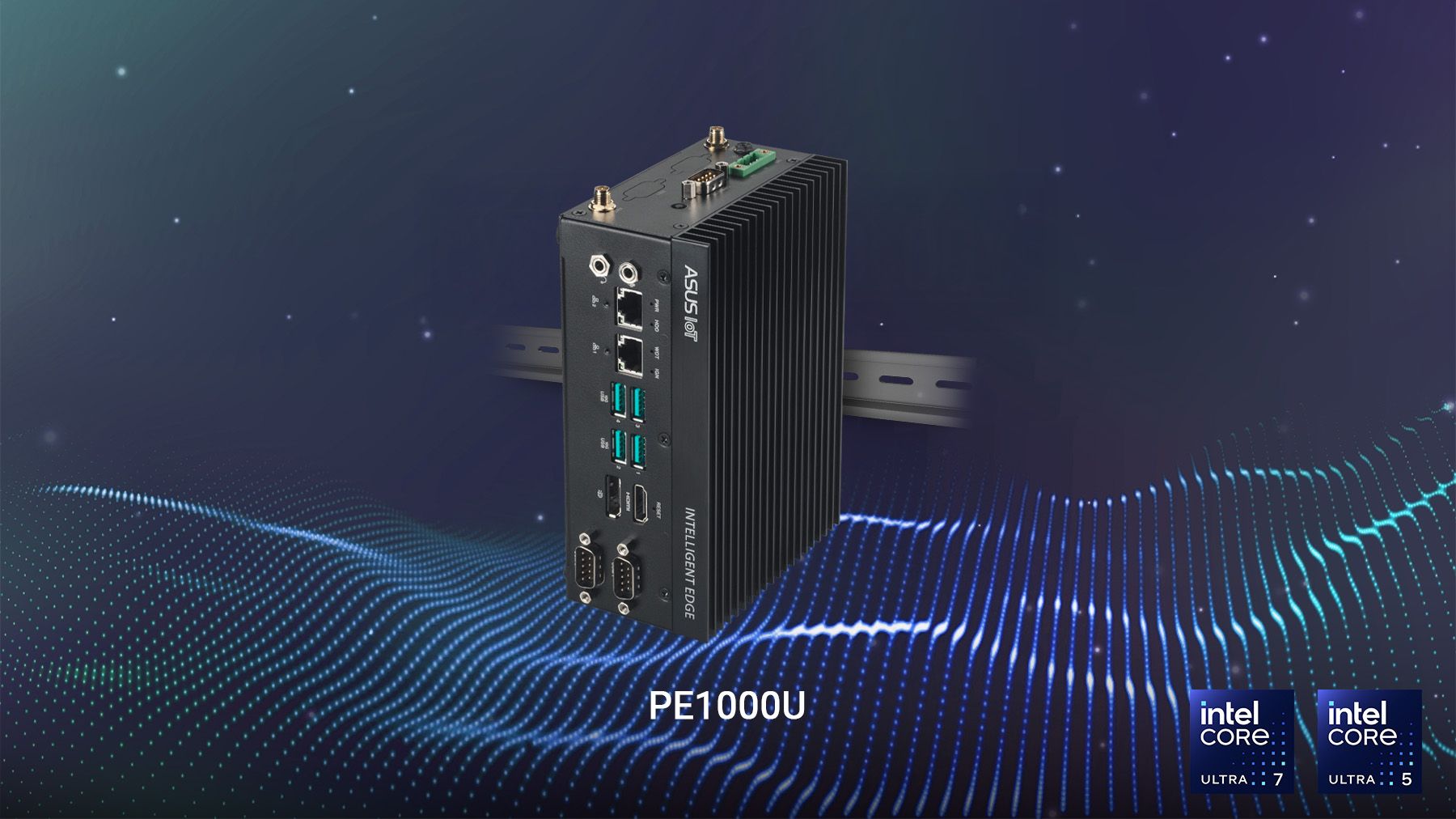
ASUS IoT has launched the PE1000U, a compact and rugged industrial PC designed for demanding edge applications. This fanless device mounts on a DIN-rail and targets autonomous mobile robots (AMR), collaborative robotics, and computer vision systems. The unit measures just 63 x 110 x 160mm, saving crucial space in control cabinets. It features an Intel Core Ultra Series 2 processor for hybrid CPU, GPU, and NPU acceleration. Consequently, it delivers the responsive performance needed for real-time motion control and AI inference. Built to withstand harsh conditions, the PE1000U operates in temperatures from -25°C to 70°C and endures significant vibration. Therefore, this industrial PC suits factory floors, on-vehicle deployments, and semi-outdoor installations where reliability is non-negotiable.
The device boasts extensive connectivity to simplify sensor and network integration. Front-panel I/O includes up to four USB ports, four COM ports, and four Ethernet ports. Two of these Ethernet ports default to 2.5G speeds. Additionally, the PC offers dual CAN Bus, an isolated digital I/O module, and supports WiFi 6E or 5G modules. DisplayPort and HDMI outputs can drive two 4K displays for human-machine interfaces or vision monitoring. The wide 9–36V DC power input with built-in ignition control makes it ideal for mobile or vehicular use. Its fanless, IP40-rated sealed chassis ensures long-term operation by excluding dust and eliminating moving parts that can fail. This combination of power, connectivity, and ruggedness positions the PE1000U as a versatile compute node for the industrial edge.
Ruggedized Design for Demanding Environments
The PE1000U industrial PC prioritizes durability with a fanless, fully sealed design. It meets IP40 standards, protecting against solid objects larger than 1mm. Moreover, it has passed US MIL-STD-810H testing for vibration resistance up to 5Grms. This ruggedization ensures reliable operation on moving platforms like AMRs or amidst machinery on vibrating factory floors. A wave-pattern aluminum heatsink directly transfers heat from the CPU and memory to the external chassis surface. This advanced thermal architecture enables silent, passive cooling without vents or fans. As a result, the system avoids dust ingress and maintains performance even in high ambient temperatures. The screw-lock connectors further secure cable connections against shocks and vibrations, guaranteeing mission-critical stability for collaborative robots and mobile equipment.
Targeted Applications: AMR, Robotics, and Machine Vision
ASUS IoT specifically designed the PE100U for three key areas. First, in Autonomous Mobile Robots (AMRs), its small size, vibration tolerance, and multiple connectivity options are crucial. The four LAN ports, dual CAN Bus, and wireless options link seamlessly to LiDAR, cameras, motor controllers, and fleet management software. Second, for collaborative robots (cobots), the device supplies deterministic compute power from its Intel Core Ultra processor. This power handles real-time perception and motion planning. The robust construction ensures stability amid continuous robotic movement. Third, in computer vision and laser processing systems, the DIN-rail form factor simplifies cabinet wiring. The multiple Ethernet ports support multi-camera arrays, while the isolated DIO module can precisely trigger strobes and illumination without introducing electrical noise into sensitive vision systems.
Processing Power and Edge AI Capabilities
At the heart of this industrial PC is an Intel Core Ultra 265U or 235U processor. This chip employs a hybrid architecture that combines performance and efficiency cores with integrated Intel Arc graphics and a dedicated Neural Processing Unit (NPU). The NPU is particularly significant; it accelerates AI inference workloads at the edge. Therefore, the PE1000U can run machine-learning models for object recognition, anomaly detection, or predictive maintenance directly where data is generated. This local processing reduces latency, conserves bandwidth, and enhances operational security by keeping sensitive data on-premises. The powerful CPU cores also ensure high single-thread responsiveness, which is essential for precise, real-time motion control in robotic applications.
Connectivity and Integration Advantages
The PE1000U stands out for its rich and versatile I/O panel. Placing all ports on a single side simplifies wiring in crowded DIN-rail cabinets. The inclusion of up to four independent Ethernet ports allows for direct connection to multiple high-resolution cameras or sensors without an external switch. The dual CAN Bus interfaces are vital for industrial automation, enabling deterministic communication with motor drives, PLCs, and other field devices. The isolated DIO module protects the core system from electrical noise and surges common in industrial settings. Furthermore, support for WiFi 6E and 5G modules provides flexible wireless connectivity for mobile applications or locations where running Ethernet cable is impractical. This comprehensive connectivity suite makes the PC a central hub for diverse edge data sources.
Market Position and Industrial Edge Trends
The launch of the PE1000U reflects broader trends in industrial automation. There is a growing demand for compact, powerful, and rugged computing at the edge to enable AMR and smart robotics. ASUS IoT enters a competitive market but differentiates with a strong focus on thermal design, extensive I/O, and specific application optimization. The product directly addresses key pain points: space constraints, environmental harshness, and the need for real-time AI processing. By combining an advanced Intel processor with a robust form factor, ASUS IoT offers a solution that bridges the gap between IT and operational technology. As factories and logistics centers become more automated, reliable industrial PCs like the PE1000U will form the critical computational backbone, making this release a strategically important one for the company’s IoT division.