Media pluralism defines the state of having a plurality of voices, opinions, and analyses in media systems (internal pluralism) or the coexistence of different and diverse types of medias and media support (external pluralism).
Media pluralism is often recognized by international organizations and non-governmental organizations as being an essential part of a democratic state, Reporters Without Borders considers “access to a plurality of editorial lines and analyses [as] essential for citizens to be able to confront ideas, to make their own informed choices and to conduct their life freely”.[1]
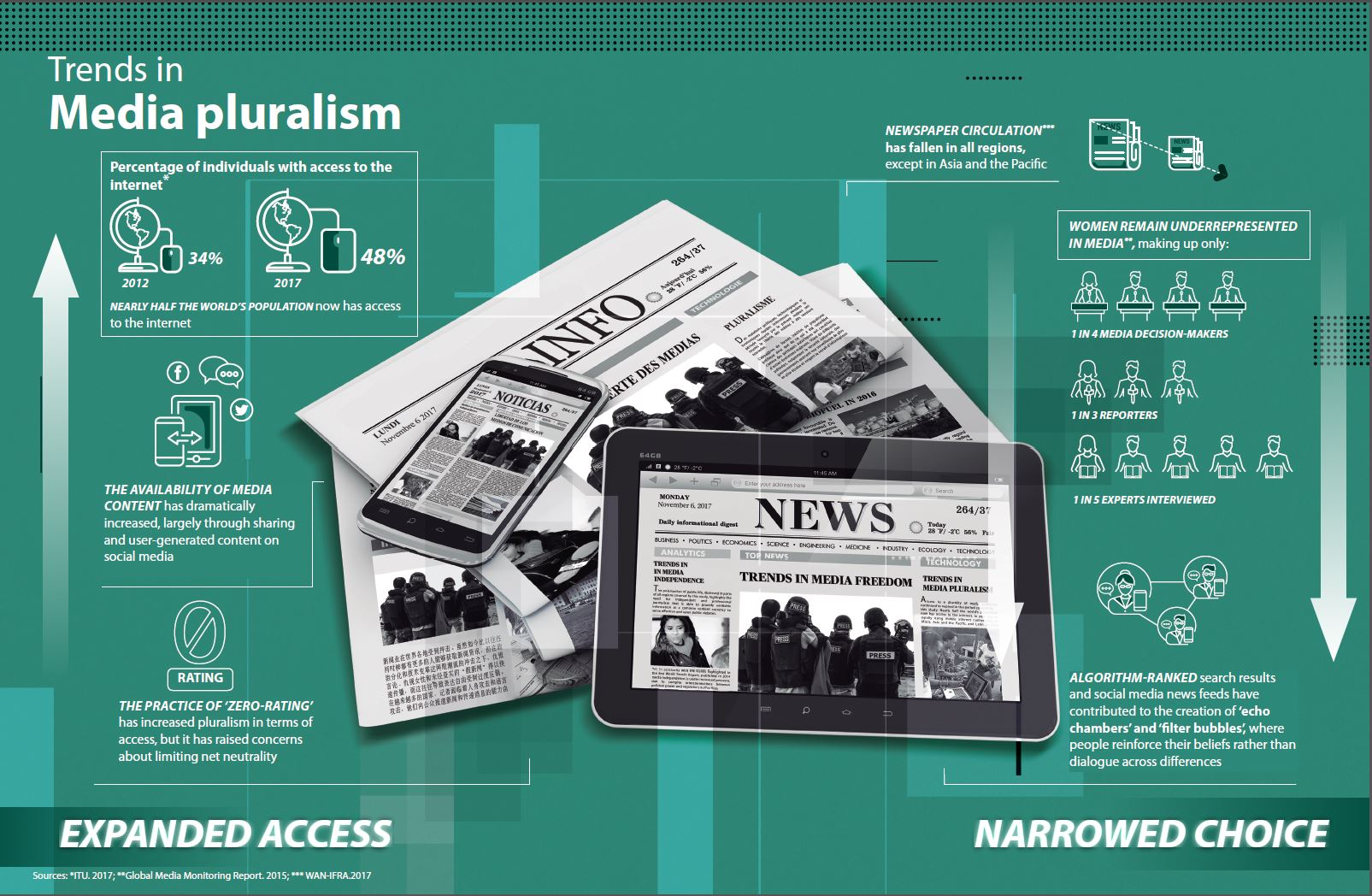
Expanded access to the Internet and the digital switch-over has enabled an increased availability of media content, largely through sharing and user-generated content on social media, in addition to the digital channels to which individuals have access across television and radio. The diversity of content is however accompanied by what Hallin and Mancini call “polarized pluralism” in a media system, in Comparing Media Systems.[3]
According to the UNESCO report on world trends in freedom of expression and media development, a sharper division in the way we use news is coming up due to the interaction between consumption habits, changing economic models and technical systems. This signifies that even if multiple kinds of information and programming are available, each segmented group may only ingest one branch of the whole. The increase of Internet penetration and reliance on online sources for news is thought of to producing siloed debates.[4]
At the infrastructural level, ‘zero rating‘— in which Internet or mobile service providers allow users to access specific content or applications without counting towards the user’s data ‘cap’— expands in parallel to mobile uptakes, particularly in emerging countries. Traditional business models for the news media continue to be disrupted, leading to vertical and horizontal concentration and introduction of new types of ownership. Challenges to media funding introduce new types of economic models such as pay-walls and crowd-funding initiatives.[4] Gender is a part of media pluralism and is characterized by the under-representation of women in the media workforce, in decision-making and in media content. People with disabilities are also under-represented in the media system.[5]
Media capture is considered the primary threat to media pluralism.[6]
Recent developments have highlighted the economic challenges facing media pluralism. UNSECO’s 2025 World Trends Report notes that digital platforms receive a growing share of advertising revenue, putting financial pressure on traditional news organizations and potentially threatening their editorial independence. These challenges can affect the resources available for producing diverse and independent news coverage.[4]
Understanding media pluralism
- Pluralism involves sensitivity to a variety of economic ownership models and a technical architecture of delivery in which multichannel and multi-platform distribution is available.
- Pluralism often resonates with strong commitments on behalf of governments to public service and community media to provide for diversity.
Jakubowicz focuses on “provisions” or “supply” of media content and the impact of available information in a society.[7] Evaluations of media pluralism have commonly explored the number of media outlets available; how comprehensively media outlets represent different groups and interests in society; and who owns or is able to influence the media.[4] The explosion of access to media through the Internet, the increasingly common practice for users to consume information across a variety of platforms, and the rise of algorithmic profiling bring to the fore questions about users and how they access—or are shielded from accessing—a plurality of sources.
Access
Access to information, as the ability for an individual to seek, receive and impart information effectively, is an aspect of media pluralism. It can include or allow “scientific, indigenous, and traditional knowledge; freedom of information, building of open knowledge resources, including open Internet and open standards, and open access and availability of data; preservation of digital heritage; respect for cultural and linguistic diversity, such as fostering access to local content in accessible languages; quality education for all, including lifelong and e-learning; diffusion of new media and information literacy and skills, and social inclusion online, including addressing inequalities based on skills, education, gender, age, race, ethnicity, and accessibility by those with disabilities; and the development of connectivity and affordable ICTs, including mobile, the Internet, and broadband infrastructures”.[8][9]
Michael Buckland defines six types of barriers that have to be overcome for access to information to be achieved: identification of the source, availability of the source, price of the user, cost to the provider, cognitive access, acceptability.[10] While “access to information“, “right to information”, “right to know” and “freedom of information” are sometimes used as synonyms, the diverse terminology does highlight particular (albeit related) dimensions of the issue.