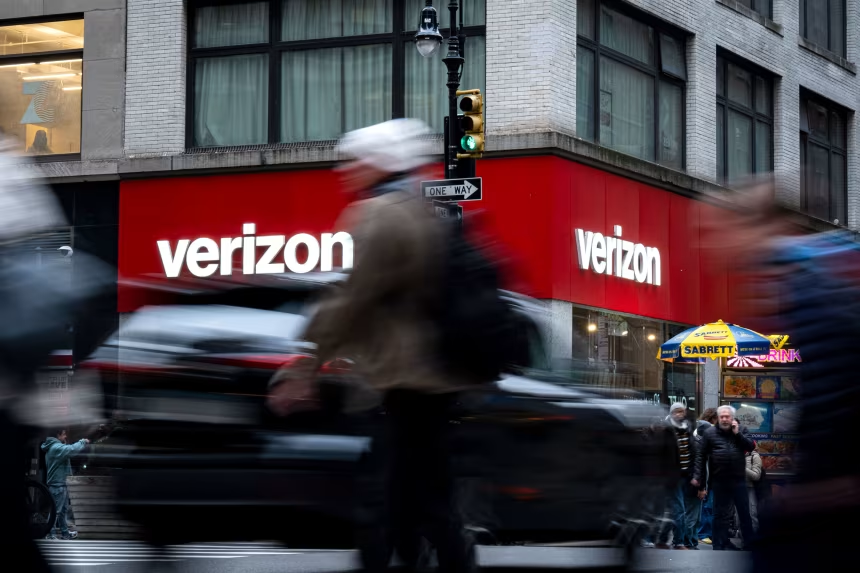
A massive Verizon outage severely disrupted daily life for thousands of customers across the United States. The network failure prevented users from making calls, sending texts, or accessing mobile internet for hours. Consequently, individuals found themselves unable to complete essential tasks. These tasks ranged from scheduling medical appointments to navigating city streets. The problem persisted until shortly before 10:30 p.m. Eastern Time on Wednesday. Verizon has not yet publicly disclosed the root cause of the widespread service disruption. However, the company announced a $20 credit for affected customers on Thursday morning.
This incident underscores the profound vulnerability of modern society to telecom failures. It follows other significant infrastructure outages, including an AT&T network failure in February 2024. Additionally, a major Amazon Web Services disruption occurred in October. The Verizon outage rendered countless people functionally disconnected. They could not verify identities for patient portals lacking received codes. Similarly, they could not receive delivery notifications or use real-time navigation. This event clearly demonstrated how cellular service has become critical infrastructure.
Personal and Professional Impacts of the Disruption
The human impact of the Verizon outage was immediate and significant. Tess Coward, a New York PR professional, woke up feeling ill. She could not contact her doctor or access her medical provider’s portal. This was because the system required a texted verification code. “If I needed anything in that moment, I couldn’t get it,” Coward stated. Her anxiety grew alongside her physical discomfort. Her experience mirrors countless others shared on social media. Frustrated subscribers reported being unable to find their way without Google Maps.
Gig economy workers faced direct professional consequences. Uber drivers and DoorDash couriers rely on constant connectivity for their livelihoods. The outage likely caused lost income and logistical chaos. Matt Crowe, a software engineer, awaited a television delivery. He missed the driver’s call due to the Verizon outage. The driver waited outside his building for twenty minutes. A text message eventually came through, but the experience was stressful. Omar Hassan, a product designer, pre-emptively downloaded maps over Wi-Fi. He refused to let the network failure cancel his dinner plans with friends.
Analyzing the Causes of Network Failures
Verizon has remained silent on the specific technical cause of the outage. Industry analysts, however, point to common vulnerabilities. Susan Welsh de Grimaldo, a Gartner communications analyst, explained the increasing role of software. Modern networks depend heavily on software-defined systems. These systems enable improvements and automation. However, they also introduce potential points of failure. Frequent configuration changes and automated updates can sometimes trigger cascading problems.
The 2024 AT&T outage was attributed to a software issue. Similarly, the October AWS disruption stemmed from an automated system bug. These incidents share a common theme. A small error in a complex, interconnected system can propagate widely. Networks have redundancies, but they are not infallible. De Grimaldo noted that minor outages likely occur regularly. They are often resolved before most users notice. This Verizon outage, however, reached a scale that made containment impossible for hours.
Societal Reliance on Constant Connectivity
The disruption served as a stark reminder of societal dependence on always-on connectivity. New York City Emergency Management actively monitored the situation. It coordinated with utility providers to assess impacts on essential city services. This official response highlights how cellular networks underpin public safety infrastructure. Furthermore, Downdetector, an outage tracking site, recorded massive user reports. Over 178,000 reports were filed within a 15-minute peak window. In total, roughly 1 million issue reports were submitted in 24 hours.
These numbers only partially capture the disruption’s true scope. Many affected users may not report issues on tracking sites. The outage disrupted both personal communications and commercial activities. It blocked the two-factor authentication processes that secure many online accounts. It also stranded people who depend on ride-sharing apps for transportation. Essentially, a single point of failure in Verizon’s network fragmented many layers of daily routine. This dependence has crept into modern life, often unnoticed until it vanishes.
Consumer Reactions and Carrier Accountability
Customer reactions ranged from frustration to resignation. For some, like Tess Coward, one major outage is not enough to prompt switching carriers. However, she admitted a repeat incident might change her mind. “In today’s age, you rely so much on your phone without even realizing,” she observed. This sentiment is widespread. The inconvenience threshold for such a vital service is remarkably high. Yet, persistent reliability issues can erode loyalty over time.
Verizon’s $20 credit is a standard goodwill gesture. It represents a small fraction of most monthly bills. The gesture acknowledges inconvenience but does not compensate for lost work or heightened anxiety. The company faces pressure to provide a transparent technical explanation. Customers and regulators alike demand accountability for critical infrastructure failures. This Verizon outage will inevitably fuel discussions about regulatory oversight and network resilience standards. It also emphasizes the risk of concentrated reliance on a few major telecom providers.
Broader Implications for Network Infrastructure
This event contributes to a growing pattern of large-scale digital infrastructure failures. Each incident prompts calls for increased investment and redundancy. The transition to software-defined networks offers efficiency. Nonetheless, it may introduce new systemic risks that require robust management. The industry must balance innovation with rock-solid reliability. This is especially true as cellular networks evolve to support more autonomous systems and smart cities.
Future planning must consider the heightened consequences of downtime. Networks are no longer merely for conversation; they are essential utilities. The Verizon outage proved that many aspects of health, commerce, and mobility now flow through these digital pipes. Building more resilient, decentralized, and transparent systems is becoming an economic and social imperative. Ultimately, this outage is a warning. It highlights the need for infrastructure that matches the critical role it plays in everyday life.